Phil Ivey Edge Sorting Scandal: How Much Did He Win and Was It Cheating?
FluxPlays Team
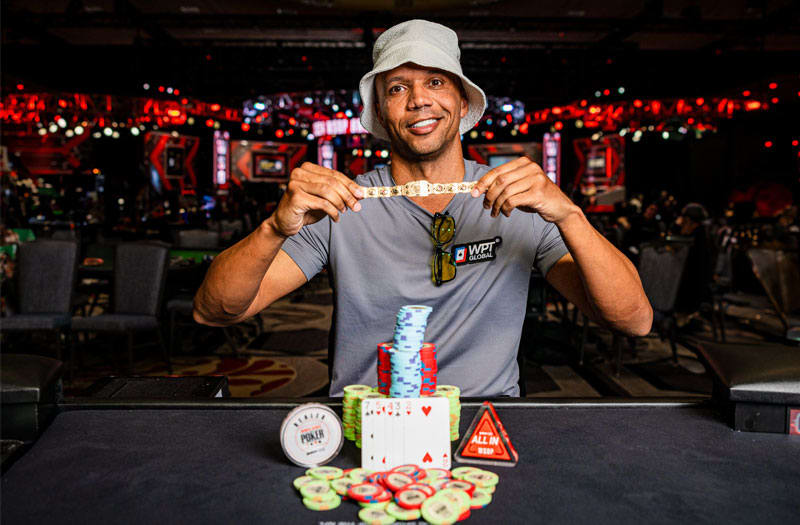
In the spring of 2012, Phil Ivey called the Borgata in Atlantic City with an unusual request.
He wanted to play mini-baccarat. Not at a normal table. He wanted a private room, a specific brand of purple Gemaco playing cards, an automatic shuffling machine, and a $50,000 maximum bet per hand. In exchange, he'd wire over a $1 million deposit just to get a seat.
Borgata said yes. High rollers ask for strange things all the time, and Ivey was the biggest fish they'd ever had a chance to land. What they didn't know was that Ivey had just described, in precise detail, every condition he needed to beat them for millions of dollars without ever touching a card.
By the time anyone figured out what had actually happened, Ivey and a quiet, little-known associate named Cheung Yin "Kelly" Sun had walked away with more money than almost anyone in casino history has ever won and then been forced to give back.
The Secret Hiding on the Back of a Card
Here's the part that sounds almost too simple to be real. Certain decks of cards, including the purple Gemaco deck Ivey specifically requested, have a tiny manufacturing flaw. The pattern printed on the back of each card isn't perfectly symmetrical. One long edge of the design is a hair wider than the other.
You'd never notice it glancing at a single card. But if you trained your eyes on it long enough, across thousands of hours of practice, you could learn to tell the difference between a card facing one way and a card facing the other.
That's exactly what Kelly Sun had done.
Her plan depended on getting half the deck, specifically the high-value cards, rotated 180 degrees relative to the rest. So during play, she'd ask the dealer to turn certain cards a particular way before they went back into the shoe. She told them it was superstition, that she believed those cards brought her luck and wanted them facing a certain direction. It was a strange request, but a harmless-sounding one. Dealers obliged without a second thought.
Round by round, card by card, Sun was quietly re-engineering the entire deck. By the time enough high cards had been turned, she could look at the unsymmetrical pattern on the back of a face-down card and know, with startling accuracy, whether it was high or low before it was ever revealed. In a game like baccarat, where the entire bet hinges on guessing high or low, that's not an edge. That's the answer key.
Neither Ivey nor Sun ever touched a card with a marker, a fingernail, or anything else. They never once broke a written rule of the game. They simply asked, and the house said yes, again and again, without understanding what they were really agreeing to.
Sun herself remains one of the most fascinating, least understood figures in modern casino history. She wasn't a poker celebrity like Ivey. Most casino-goers had never heard her name until this case made headlines. But within the small, secretive world of professional advantage players, she had quietly built a reputation as someone who could do something almost nobody else could: train her eyes to catch a printing flaw smaller than a millimeter wide, consistently, under casino lighting, in the middle of a live game, without ever slowing down play enough to draw suspicion. That skill alone, separate from anything Ivey brought to the table, is arguably the real engine behind both wins. Her story was compelling enough that a feature film was later made about her role in the case.
The Wins That Shocked Two Casinos
 High-limit baccarat table where edge sorting was executed
At Borgata, across four sessions between April and October of 2012, the technique worked exactly as planned. Ivey and Sun walked away with approximately $9.6 million. The casino paid every dollar without hesitation. As far as Borgata was concerned, a legendary poker player had simply gotten lucky at their tables, and lucky high rollers are good for business. They wanted him to come back.
Across the Atlantic, the same play was already in motion at one of London's most prestigious casinos.
At Crockfords, Ivey and Sun ran the identical strategy and won roughly £7.7 million, about $12 million at the time. But this time, something was different. Crockfords looked at the size of the win, looked at the unusual table requests that had preceded it, and got suspicious. They refunded Ivey's original £1 million stake. Then they simply refused to pay out the rest.
They told him, to his face, that they believed he had cheated.
Ivey was furious. He'd done nothing, in his mind, that crossed any line. He hadn't touched a card. He hadn't broken a single written rule. He'd simply noticed something the casino itself had failed to catch, and turned it to his advantage, the same way a sharp player exploits any edge at the table. So he did what any high-stakes player with the means to fight back would do.
He sued them.
The Fight That Lasted Eight Years
What Ivey didn't know yet was that suing Crockfords would set off a chain reaction that would consume the next eight years of his life and put more than $20 million permanently out of his reach.
The Crockfords case dragged through the English High Court, then the Court of Appeal, then finally the UK Supreme Court. And here's where the story takes its strangest turn. The trial judge looked at everything Ivey had done and made an almost unbelievable finding: Ivey was telling the truth. He genuinely, honestly believed his technique was legitimate advantage play, not cheating. The judge said so directly. Every appeals judge after him agreed on that single point.
And Ivey still lost. Every single time.
The Supreme Court's reasoning was almost philosophical. Honesty, they ruled, wasn't actually the question. The real question was whether Ivey had taken active, deliberate steps to manipulate the physical conditions of the game in his favor, and whether that interference itself counted as cheating, regardless of what Ivey believed in his own mind. Lord Hughes didn't mince words. What Ivey had done, he wrote, was stage "a carefully planned and executed sting."
Ivey couldn't believe it. "The trial judge said that I was not dishonest, and the three appeal judges agreed, but somehow the decision has gone against me," he said afterward. "Can someone tell me how you can have honest cheating?"
Nobody had a good answer for him. The £7.7 million stayed with Crockfords for good.
Meanwhile, an ocean away, the Borgata situation had just gotten infinitely worse.
The Trap Closes in Atlantic City
Once news of the Crockfords ruling became public, Borgata realized exactly what had happened in their own private room two years earlier. In 2014, they sued Ivey and Sun, demanding the $9.6 million back.
This case took a different shape entirely. A US federal judge actually dismissed Borgata's claims of outright fraud. But he found something else, something almost as damaging: by manipulating the deck into an effectively marked state, Ivey and Sun had violated New Jersey's Casino Control Act, the law governing how the game itself had to be played. It didn't matter that no one had physically marked a single card. The deck had been functionally altered, and that was enough.
In 2016, the court ordered Ivey and Sun to repay the original winnings, plus additional damages. The final number came to roughly $10.1 million, more than he'd actually won in the first place.
Ivey fought it for years. He appealed. He argued the payment would cause him "irreparable harm." Borgata, in turn, came after him relentlessly, eventually winning the right to chase his assets across state lines into Nevada. In 2019, they tracked him down at the one place he couldn't hide: the World Series of Poker, where they seized over $124,000 of his tournament winnings the moment he cashed out.
It wasn't until July 2020, eight years after he first picked up the phone and called Borgata about a private baccarat room, that Ivey and the casino finally reached a confidential settlement and closed the case for good.
Two countries. Two completely different legal arguments. The same ending both times. Phil Ivey, one of the most successful poker players who has ever lived, walked away from his greatest single score with nothing.
Here's the side-by-side breakdown of how the two cases actually compared:
| Crockfords (London) | Borgata (Atlantic City) | |
|---|---|---|
| Amount won | ~£7.7 million (~$12 million) | ~$9.6 million |
| Did the casino pay out? | No, refused immediately | Yes, paid in full at the time |
| Legal action | Ivey sued the casino for payment | Casino sued Ivey two years later |
| Court's reasoning | Cheating under UK civil law, despite no dishonesty finding | Breach of New Jersey's Casino Control Act (deck rendered effectively marked) |
| Final outcome | Ivey lost on final appeal, 2017 | $10.1 million judgment, settled confidentially in 2020 |
| Money Ivey kept | $0 | $0 |
So Was It Actually Cheating?
People still argue about this, and honestly, it's not a crazy debate to have.
Ivey and Sun never touched a card. They never peeked at anything they weren't allowed to see. Every single thing they did was, technically, a request the dealer was free to refuse. Compare that to other forms of advantage play that courts and casinos have historically tolerated, like hole carding or shuffle tracking, and edge sorting doesn't look obviously different.
But four separate judges, across two legal systems, looking at the same basic facts, all landed in the same place. The line wasn't about secrecy or dishonesty. It was about active manipulation. Noticing a flaw is one thing. Engineering the dealer, piece by piece, into creating the exact deck state you need is another. That's the line both courts drew, even when they couldn't fully agree on why.
What Changed Because of Phil Ivey
The industry didn't just shrug this off. High-limit rooms changed in concrete ways because of what happened in that private Borgata room.
Card manufacturers tightened their printing standards so the kind of asymmetry Sun exploited became far harder to find. Automatic shufflers, once a high-roller convenience, became close to mandatory at serious tables, removing the predictable deck states that techniques like this depend on. And dealers everywhere got trained to recognize exactly the kind of "turn this card for luck" request that once sounded completely harmless.
But the real lesson isn't really about cards. It's about leverage. Phil Ivey is, by any measure, one of the smartest players to ever sit at a table, and he still spent eight years and tens of millions of dollars fighting two of the world's biggest casinos, and lost both fights completely. If the house can outlast someone with his resources, it's worth remembering what you're actually up against any time you think you've found the angle nobody else has noticed.
A Story Worth Knowing, Not Repeating
This isn't a strategy you could run today even if you wanted to. It required a once-in-a-generation eye for sub-millimeter printing flaws, a casino willing to grant highly unusual table conditions, and, in the end, two devastating legal defeats. What's left is one of the most fascinating cautionary tales in modern gambling history.
If the appeal of this story is watching a game play out in real time the way that Borgata room did, just with full transparency instead of a private deal nobody else could see, our Gates of Olympus Roulette live tracker and Sweet Bonanza Candyland live tracker show genuine round-by-round results as they happen. And if you're choosing where to actually play, our casino reviews only cover operators we've tested ourselves, licensing, payout speed, and all.
Frequently Asked Questions
How much did Phil Ivey win from edge sorting? Combined across both casinos, Ivey and Sun won approximately $21 to 22 million in 2012: roughly £7.7 million ($12 million) at Crockfords in London, and $9.6 million at Borgata in Atlantic City. He ultimately kept none of it.
Did Phil Ivey go to jail for edge sorting? No. Both cases were civil lawsuits, not criminal prosecutions. Ivey was never charged with a crime. The consequences were entirely financial.
Is edge sorting illegal? It depends on the legal system and the specific facts. The UK Supreme Court ruled it constituted cheating under UK civil law. A US federal court ruled it violated New Jersey's Casino Control Act because it relied on a deck rendered effectively marked, even without physical alteration. Both rulings were specific to those courts and those facts.
Did Phil Ivey actually mark the cards? No. Neither Ivey nor Sun ever touched, marked, or physically altered a card. They asked the dealer to rotate specific cards during normal play, exploiting an existing manufacturing flaw rather than creating a new one.
Is edge sorting still possible today? Far less so. Most high-limit casinos now use cards with corrected, symmetrical printing specifically because of this case, and automatic shufflers are standard at the stakes where edge sorting would matter. The exact conditions that made Ivey and Sun's run possible have largely been closed off across the industry.
This article is provided for informational purposes about a matter of public legal record. Phil Ivey is referenced solely as a public figure in connection with widely reported court proceedings. FluxPlays encourages responsible gambling. Play should be entertainment, not a strategy for income. If you or someone you know is struggling with gambling, support is available at BeGambleAware.org.
Suggested title: Phil Ivey Edge Sorting Scandal: How Much Did He Win and Was It Cheating?
Suggested meta description: The full story of Phil Ivey's $22 million edge sorting scandal at Crockfords and Borgata. How the technique worked, what the courts ruled, and why he kept none of the money.

🎁 400% up to 4,000 EUR
This article is for informational purposes only. Gambling involves risk. 18+ only. Play responsibly, visit BeGambleAware.org